

The grant program is currently open as of August 5, 2026.
Applications and supporting materials are due by midnight (12:00 am) on September 18, 2026. CFAA must receive a digital copy of the application and all supplemental materials by email to [email protected].
Please download the below application and SMART Project Budget Table documents.
Learn more about the Capital Food Access Alliance.
Any non-profit organization, business, or entity who has previously applied for a past CFAA grant opportunity and is in good standing (Microgrant, Equipment Grant, or Expansion Project Grant), operating within the cities of Citrus Heights, Elk Grove, Galt, Folsom, Rancho Cordova, Sacramento and/or the Unincorporated areas of Sacramento County that collects and/or distributes recovered edible food are eligible for this round of grant funding. If your organization was awarded funds from any of these previous grant opportunities, you must be in good standing with CFAA (no late reports, no missing application information, etc.) to be eligible.
Eligible agencies may submit one application, which has a designated funding allocation of up to $25,000. Collaborative applications involving multiple nonprofit organizations (NPOs) and Tier 2 edible food recovery programs are encouraged and will be prioritized. The cap for collaborative applications will be $50,000 in total.
Applications and supporting materials are due by midnight (12:00 am) on September 18, 2026. CFAA must receive a digital copy of the application and all supplemental materials by email to [email protected].
The following is the timeline for the CFAA Supplemental Award Grant.
Date | Activity | Description |
August 31, 2026 | Q&A session | Abound will host an open question and answer session on this date. For those who will not be able to make it, you are welcome to email questions about this grant in advance. We will do our best to continue to answer program questions submitted via email between September 1, 2026 – September 14, 2026. |
September 18, 2026 | Application due date | Grant application and supporting materials due by email to [email protected] |
October 9, 2026 | Award notification & formal agreement | Upon award, the lead applicant will be notified by the Abound Food Care team of the total funding approved and all capital requests. Abound staff will work with applicants to finalize grant funding details and prepare the formal agreement for signature. |
October 30, 2026 | Disburse funds | CFAA will disburse funds no later than this date. Once an application is approved, Abound will call the grant recipient to receive your ACH banking information, if we do not already have it. |
January 29, 2027 | Grantee to spend allocated funds | Grant funds received must be spent no later than this date in order to be able to complete reporting by the final report due date, or risk returning the unspent funds. |
April 30, 2027 | Final Report Due | Grant term is scheduled to conclude by the end of April. Final report must be submitted by email to [email protected] by this date. |
Applications will have you confirm:
Prior to award, the CFAA will host a virtual Q&A Session on the date specified in the table above. If your organization is unable to attend the virtual session, we welcome questions submitted via email. Abound will do our best to be available to address any questions regarding the grant program between the dates specified. Please note that after this period, the Abound team will no longer answer questions.
Frequently asked questions are below.
This grant program provides supplemental funding to support organizations working to increase access to nutritious food and strengthen edible food recovery efforts throughout Sacramento County. Funding may be used to expand organizational capacity, improve Tier 1 and Tier 2 food recovery and distribution operations, support collaborative projects, and reduce barriers to serving communities experiencing food insecurity.
If your organization was awarded funds from any of the previous grant opportunities, you must be in good standing with CFAA (no late reports, no missing application information, etc.) to be eligible.
Any non-profit organization, business, or entity who has previously applied for a past CFAA grant opportunity (Microgrant, Equipment Grant, or Expansion Project Grant), operating within the cities of Citrus Heights, Elk Grove, Galt, Folsom, Rancho Cordova, Sacramento and/or the Unincorporated areas of Sacramento County that collects and/or distributes recovered edible food are eligible for this round of grant funding.
You may be a non-profit organization, business, or public entity operating within the cities of Citrus Heights, Elk Grove, Galt, Folsom, Rancho Cordova, Sacramento and/or the Unincorporated areas of Sacramento County that collects and/or distributes recovered edible food.
Collaborative applications involving multiple eligible organizations are encouraged and will be prioritized.
Yes, funding must directly benefit food recovery efforts in the Sacramento County region.
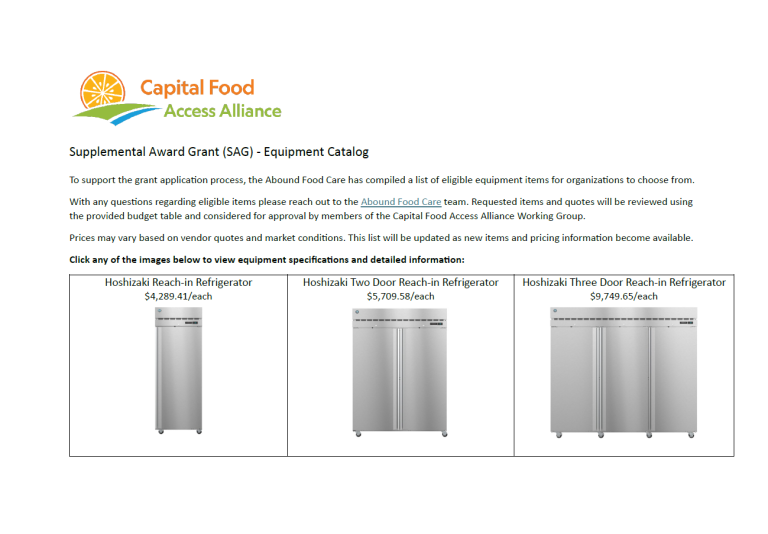
Expenses may include, but are not limited to the following items. To support the grant application process, the Abound Food Care has compiled a list of eligible equipment items for organizations to choose from.
Organizations may request specific equipment items that better align with their program operations.
Eligible personnel funding cap: Staff time for grant administration (limited at 15% of total budget request). For personnel costs, details regarding activities, staff rates, and total hours will be required with full applications. Please note that consultant, subcontractor, and vendor costs are not eligible personnel costs.
If you have a question about if a piece of equipment is eligible for funding, please reach out to us.
Eligible staff time activities include:
Requests to fund staff wages directly tied to the project, other than those described above, will be assessed on a case-by-case basis. Applicants will be asked to describe the measurable impact of temporary funding for staffing. For example, a shared driver.
Yes, but this request will be assessed on a case-by-case basis by the Capital Food Access Alliance.
If you would like to propose a shared driver in your application, we will want to know basic information about the program, such as how the arrangement will work, how the driver’s time and schedule will be shared, the geographic area and anticipated number of food pickups and deliveries, what food recovery needs it addresses, and how the driver’s time and costs will be allocated.
Applicants should also describe which organization will employ and supervise the driver, how transportation-related costs will be managed, and how participating organizations will coordinate scheduling and track program outcomes.
Changes may require written approval from the grant administrator. Recipients should contact CFAA before making significant changes to the approved project, budget, or timeline.
No.
Lead applicants cannot apply or submit multiple applications.
If you are lead on an application, you are able to apply as a sub applicant with another organization, but you may not be a “second lead.”
Abound Food Care is available to assist you with your application or answer questions by request through [email protected]. Applicants will be scored based on their ability to fully and completely address all elements of this grant application, in addition to the commitment to meet grant timelines, particularly reporting requirements. Higher scores will be provided to applicants that can demonstrate collaboration and the ability to meet all reporting requirements.
Notice: CFAA reserves the right to modify the grant timeline should it deem, in its sole discretion, to be in the best interest of. If any changes are made, CFAA will send a notification by email to all potential applicants and awarded grantees as necessary.
CFAA reserves all its rights and options including, without limitation:
Eligible applicants may submit only one of the following two types of grant applications:
Please fill out all information accurately and completely. You are welcome to add more information to your application such as cover letter or letter of recommendation, but it is not a requirement.
Click to view a complete example application.
Organization Name: |
Applicant Name (First and Last): |
Are you a certified 501(c)3 non-profit organization? If not, please explain. |
Please state if you are applying for an individual application or a joint application. If you are filing a joint application, please list all participating partners. |
Do you accept prepared food and/or food from a Tier 2 Generator? (Yes or no) |
Do staff members and volunteers maintain appropriate food handler or food safety manager certifications as necessary or required by state or local mandates? If applicable, Abound may request a Food Safety Certificate and more information to demonstrate compliance. |
Please describe: A. The project you are applying for; B. An outline of your organization’s plans for growth over the next year; and, C. Explain how you intend to develop recovery capacity with the requested items. |
Describe if this project is collaborative, can assist with recovering prepared food and/or food from Tier 2 generators and how this equipment can assist your organization with food recovery. |
Total funding amount requested: Note that the funding limit is capped at $25,000, unless partnering with other organizations. If you are partnering with other organizations, then the cap is $50,000. |
Please provide the last six months of food recovery data available (January 2026 – June 2026). As a grant requirement, organizations must be able to provide the total amount of pounds recovered monthly.
If you are using a tracking platform, you can provide data from that system in lieu of completing the table below. If you do supply data from your tracking platform, please provide specific details about what is included (e.g. Does this include recovery data from all sources or Tier 1 and Tier 2 regulated entities only?).
If you need more information on the distinction between Tier 1 and Tier 2 generators, please visit CalRecycle’s page on Food Donors – https://calrecycle.ca.gov/organics/slcp/foodrecovery/donors/ or the list of generator definitions linked here.
Please provide food recovery data, recovery/ pick-up schedule, and distribution schedule in your submitted application.
Please fill out the attached SMART Project Budget Table. This spreadsheet must be completed in order for the application to be considered eligible. (Required)
Note: The quotes or estimates you provide in this application may change over time due to market fluctuations and supply chain conditions. Be sure to account for shipping costs and tax. CFAA is not responsible for any cost increases, so please plan accordingly.
Eligible expenses may include, but are not limited to the following:
Eligible personnel funding cap: Staff time for grant administration (limited at 15% of total budget request). For personnel costs, details regarding activities, staff rates, and total hours will be required with full applications. Please note that consultant, subcontractor, and vendor costs are not eligible personnel costs.
Eligible staff time activities include:
Requests to fund staff wages directly tied to the project, other than those described above, will be assessed on a case-by-case basis. Applicants will be asked to describe the measurable impact of temporary funding for staffing. For example, a shared driver.
Ineligible expenses include the following:
Purchase or leasing of buildings or properties; Construction; Purchase of food; Expenses incurred before or after the grant term; Purchase or lease of vehicles and/or related expenses; Any items that do not directly increase food recovery capacity; Staff costs in excess of 15% of total budget.
Your application will have you confirm your commitment to completing the included activities during your grant period.
The CFAA subcommittee will review all grant applications, select finalists, and may request follow-up information prior to making the final selection.
Prior to the commencement of work, the grant awardee and Abound Food Care will review and sign the entered upon Agreement. By submitting your application, you acknowledge your understanding of this.
Submit your completed grant application through email to [email protected] with the subject line: [Your organization’s name] Supplemental Award Grant Application.
If you have not received confirmation within a week of submittal, please reach out to Abound Food Care for assistance.
For your awareness, awarded applicants will need to provide reporting and supporting documentation to comply with the award terms.